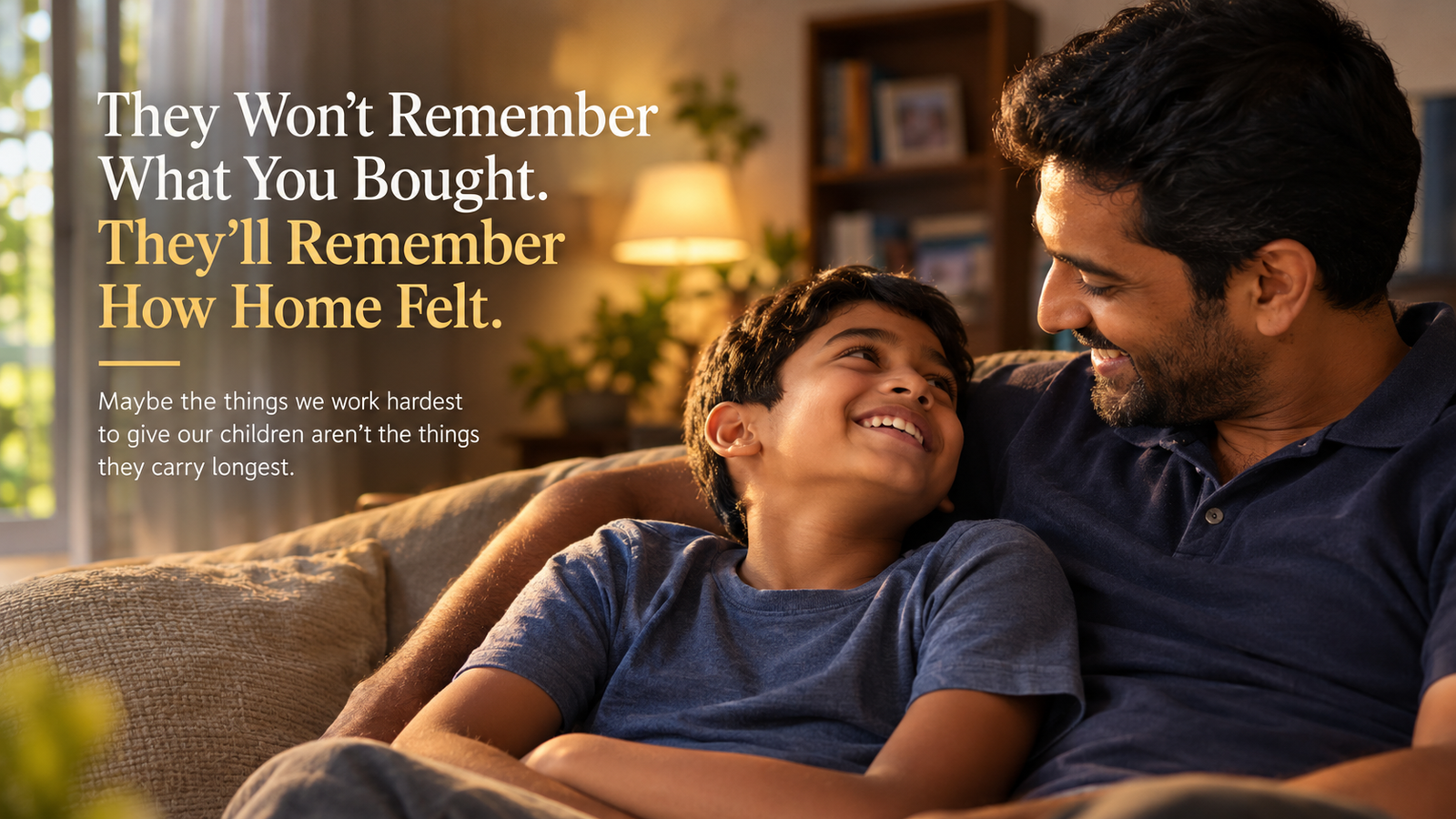
THEY WON’T REMEMBER WHAT YOU BOUGHT. THEY’LL REMEMBER HOW HOME FELT.
Maybe the things we work hardest to give our children aren’t the things they carry longest.
Think of the adults who raised you.
Can you recall their schedules? Every lesson they taught? Everything they bought?
Probably not.
But you remember a tone of voice. Someone who stopped what they were doing to listen. The feeling of being safe. And sometimes, the feeling of not being understood.
So here is the question I can’t put down:
When our children grow up, what will they remember about us?
We work hard to give them the right things: education, good food, opportunities, rules, protection. All of it matters. But we also give them something harder to measure.
A sense of what it feels like to be around us.
The Memories We Don’t Plan
We imagine childhood memories as big events. Birthdays. Holidays. School prizes.
Yet the ones that stay are often small. Sitting beside someone while they drank tea. Being picked up after a fall. Laughing at a joke nobody else found funny. One sentence you never expected to remember.
Memory isn’t a video recording. Researchers who study parent–child conversations have found that when adults talk with children about their experiences, asking questions, adding details and talking about feelings, children tend to build richer, more detailed memories of those experiences.
Sometimes a simple question does the work:
“What happened next?”
“How did that feel?”
It quietly tells a child: your experience is worth remembering.
The Story After The Mistake
A child comes home after failing an exam.
One parent says, “Why didn’t you study properly?”
Another says, “I know you’re disappointed. Let’s see what happened.”
The result is identical. The meaning isn’t.
In the first conversation, a child may learn: failure means I’m not good enough. In the second: failure hurts, but I can understand it and try again.
We can’t control every memory our children will form, and we shouldn’t try. But we can shape the story that surrounds it.
Parenting Is Also Atmosphere
A child speaks. Do we look up?
A child is frightened. Do we say, “Stop being dramatic”?
A child wants to confess something embarrassing. Do we laugh, or listen?
Developmental research points to the importance of responsive relationships: ordinary back-and-forth moments when a child reaches out and an adult notices.
No parent gets this right every time. We get tired. We lose patience. We shout.
Good parenting isn’t never making mistakes. Often it’s what happens afterwards: the apology, the conversation, the hug, the decision to try again.
So What Will They Remember?
Maybe not every school fee we struggled to pay. Maybe not the expensive present.
But perhaps how they felt when they came to us after failing. Whether they were allowed to make mistakes. Whether they could tell us the truth. Whether love disappeared when they disappointed us.
So maybe the question isn’t “What will my child remember about me?”
It’s “What will my child remember feeling when they were with me?”
One day they’ll have difficult days of their own and, perhaps, children too. What we gave them won’t come back as a sentence they can quote. It will come back as a feeling they know how to give another human being.
Maybe our greatest inheritance isn’t what our children remember about us. It’s what our presence taught them about being human.



Join the Conversation
0 comments
No comments yet
Be the first person to comment.