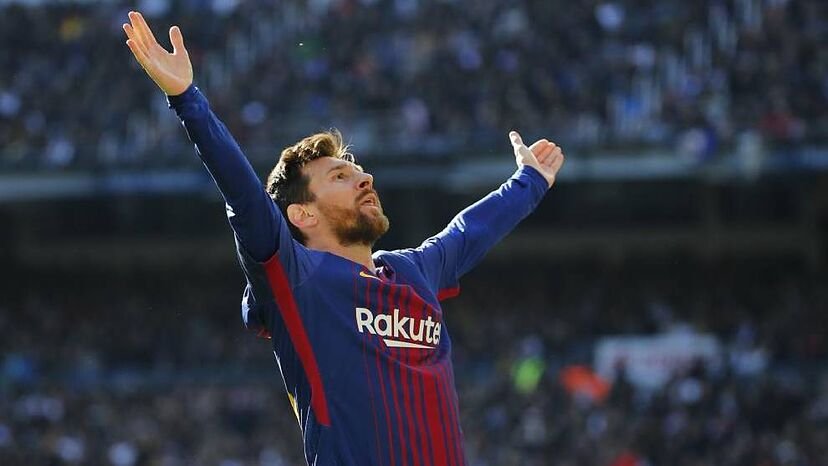
Lionel Andrés "Leo" Messi[note 1] (born 24 June 1987) is an Argentine professional footballer who plays as a forward for and captains both Major League Soccer club Inter Miami and the Argentina national team. Widely regarded as one of the greatest players in history, Messi has set numerous records for individual accolades won throughout his professional footballing career, including eight Ballons d'Or, six European Golden Shoes, and being named the world's best player by FIFA eight times.[note 2] In 2025, he was named the All Time Men's World Best Player by the IFFHS.
Messi is the most decorated player in the history of professional football, having won 46 team trophies.[note 3] His records include most goals in a calendar year (91), most goals for a single club (672 for Barcelona), most goals in La Liga (474), most goals in the FIFA World Cup (20), and most assists in international football (61). Messi has scored over 910 senior career goals and provided over 410 assists for club and country, resulting in over 1,320 goal contributions—the highest total in the sport's history.[25]
In 2004, Messi made his competitive debut for Barcelona at age 17. He gradually established himself as an integral player for the club, and during his first uninterrupted season in 2008–09 he helped Barcelona achieve the first treble in Spanish football. This resulted in Messi winning the first of four consecutive Ballon d'Ors, and by the 2011–12 season he had set the European record for most goals in a season and established himself as Barcelona's all-time top scorer. During the 2014–15 season, where he became the all-time top scorer in La Liga, he led Barcelona to a historic second treble, earning his fifth Ballon d'Or.
Messi was named Barcelona's captain in 2018. While playing for the club, he won a club-record 34 trophies, including ten La Liga titles and four UEFA Champions Leagues. Financial difficulties at Barcelona led Messi to depart in 2021 and sign with Paris Saint-Germain, where he won the Ligue 1 title twice and was awarded the Ligue 1 Foreign Player of the Year for 2022–23. He joined the Major League Soccer club Inter Miami in 2023 and led them to their first MLS Cup victory in 2025, while also winning back-to-back league MVP awards in 2024 and 2025.
An Argentine international, Messi is the national team's all-time leading goalscorer and most-capped player. Several years after his senior debut in 2005, he won the gold medal at the 2008 Summer Olympics. Assuming captaincy in 2011, he led Argentina to three consecutive finals in the 2014 World Cup, the 2015 Copa América and the Copa América Centenario, all of which they lost. After announcing his retirement from international football in 2016, he returned to help Argentina qualify for the 2018 World Cup. Messi was central to ending Argentina's 28-year trophy drought by winning the 2021 Copa América. In 2022, he led Argentina to a World Cup victory, the country's first in 36 years. Messi claimed his third major international title after Argentina won the 2024 Copa América.
Messi has endorsed the sportswear company Adidas since 2006. He was ranked the world's highest-paid athlete by Forbes in 2019 and 2022, and was among Time's 100 most influential people in the world in 2011, 2012, and 2023. In 2020 and 2023, he was named the Laureus World Sportsman of the Year, the first team-sport athlete to win the award. In 2020, Messi became the second footballer and second team-sport athlete to surpass $1 billion in career earnings. In 2026, he appeared on the World's Billionaires list for the first time with a net worth of $1.1 billion.[26] Following his arrival and impact on football in the United States, Messi was named Time's Athlete of the Year in 2023, and was awarded the Presidential Medal of Freedom by US president Joe Biden in 2025.
Early life
Lionel Andrés Messi was born on 24 June 1987 in Rosario, Santa Fe Province,[27] the third of four children of Jorge Messi, head of department at the Acindar pressed steel manufacturer in Villa Constitución, and his wife Celia Cuccittini, who worked in a magnet manufacturing workshop. His parents met as youngsters in Rosario's south-eastern district of Las Heras, where Messi himself later grew up, and married on Jorge Messi's completion of military service in the Argentine Armed Forces in 1978. On his father's side, Messi is of Italian and Spanish descent, the great-grandson of immigrants from the north-central Adriatic Marche region of Italy (with his surname coming from Porto Recanati), and on his mother's side he has primarily Italian ancestry.[3][28] Growing up in a tight-knit, football-loving family, "Leo" developed a passion for the sport from an early age, playing constantly with his older brothers, Rodrigo and Matías, and his cousins, Maximiliano and Emanuel Biancucchi, both of whom became professional footballers.[29]
At the age of four, Messi joined the local football club Abanderado Grandoli where he was coached by his father. His maternal grandmother, Celia, accompanied him to training and matches.[30] He was greatly affected by her death, shortly before his eleventh birthday. Since then, as a devout Catholic, he has celebrated his goals by looking up and pointing to the sky in tribute to his grandmother.[31][32]
Youth career
Newell's Old Boys
"When you saw him you would think: this kid can't play ball. He's a dwarf, he's too fragile, too small. But immediately you'd realise that he was born different, that he was a phenomenon."
— Newell's Old Boys youth coach Adrián Coria, sharing his first impression of the 12-year-old Messi[33]
Messi started playing for the Rosario-based football club Newell's Old Boys when he was seven years old; he would become a lifelong supporter of the club. During the six years he played for Newell's, he scored almost 500 goals, and was a member of "The Machine of '87", a nearly unbeatable youth team named for the year of their birth. Messi regularly entertained crowds by performing ball tricks during half-time, when the Newell's first team played home games.[B] His goalscoring idol growing up was Brazilian striker Ronaldo, who Messi called "the best forward I've ever seen".[37]
Messi's future as a professional player was threatened when, at the age of 10, he was diagnosed with a growth hormone deficiency. He began growth hormone therapy at age 11;[38] however, his father's health insurance covered only two years of the therapy, which cost at least 1,000 pesos per month. Newell's agreed to contribute, but later reneged on their promise.[39] Messi was scouted by the Buenos Aires club River Plate, whose playmaker Pablo Aimar he idolised.[40][41] It was speculated for a time that Messi failed to sign with River Plate due to his ill health; however, in a 2019 interview, he revealed that River Plate had wanted to sign him after he scored four goals at a trial, and even offered to pay for his medical treatment, but Newell's refused to release his player card, preventing the transfer.[42]
Barcelona
As the Messi family had relatives in Catalonia, they sought to arrange a trial with Barcelona in September 2000, when Messi was 13. First-team director Carles Rexach immediately wanted to sign him, but the board of directors hesitated; at the time it was highly unusual for European clubs to sign foreign players of such a young age. On 14 December, an ultimatum was issued for Barcelona to prove their commitment, and Rexach, with no other paper at hand, wrote a contract on a paper napkin.[40][43] In February 2001, Messi's family relocated to Barcelona, where they moved into an apartment near the club's stadium, Camp Nou.[43]
During his first year in Spain, Messi rarely played with the Infantiles due to a transfer conflict with Newell's; as a foreigner, he could only be fielded in friendlies and the Catalan league. Without football, he struggled to integrate into the team. He was reserved by nature, and was so quiet that some of his teammates initially believed he was mute. At home, he suffered from homesickness after his mother moved back to Rosario with his brothers and younger sister, María Sol, while he stayed in Barcelona with his father.[C]
_(Barcelona)_-_1.jpg)
At age 13, Messi enrolled at Barcelona's youth academy, La Masia.
After a year at Barcelona's youth academy, La Masia, Messi was enrolled in the Royal Spanish Football Federation (RFEF) in February 2002. He could now play in all competitions, and he quickly befriended his teammates, including Cesc Fàbregas and Gerard Piqué.[45] After completing his growth hormone therapy at age 14,[46] Messi became an integral part of the "Baby Dream Team", which has been lauded as Barcelona's greatest-ever youth team. During his first full season (2002–03), he was the top scorer with 36 goals in 30 games for the Cadetes A, who won an unprecedented treble of the league, the Spanish cup, and the Copa Catalunya.[45][47] In the Copa Catalunya final, their 4–1 victory over Espanyol became referred to in club lore as the partido de la máscara, the "final of the mask". A week after suffering a broken cheekbone during a league match, Messi was allowed to play on the condition that he wear a protective plastic mask. When the mask became a hindrance, Messi took it off and scored two goals within 10 minutes.[48] At the end of the season, he received an offer to join the English football club Arsenal, but he chose to remain in Barcelona.[D]
Messi continued to progress through his club's ranks at a rapid pace, debuting for four youth teams during the 2003–04 season.[51] After being named player of the tournament in four separate international pre-season competitions with the Juvenil B, he played only one official match with the team before being promoted to the Juvenil A. In the Juvenil A he scored 18 goals in 11 league games.[52][53] During the international break, Messi was one of several youth players called up to strengthen the depleted first team. Ludovic Giuly, one of Barcelona's wingers, described Messi's performance during a training session: "He destroyed us all ... He would dribble past four players and score a goal. Even the team's starting centre-backs were nervous ... He was an alien."[54]
"It seemed as if he had been playing with us all his life."
— Barcelona's then assistant coach Henk ten Cate on Messi's first-team debut.[55]
At 16 years old, Messi made his first-team debut when he came on in the 75th minute during a friendly against FC Porto on 16 November 2003.[43][56] His performance impressed the technical staff, and he subsequently began training daily with the club's reserve team, Barcelona B, as well as weekly with the first team.[57] After Messi's first training session with the senior squad, Barcelona's new star player Ronaldinho told his teammates that he believed the 16-year-old would become an even better player than himself.[58] Ronaldinho called Messi "little brother", and his friendship greatly eased Messi's transition onto the first team.[59][60]
To gain further match experience, Messi joined his club's third team, Barcelona C, in addition to the Juvenil A. He helped save the third team from the relegation zone of the Tercera División, scoring five goals in ten games, including a hat-trick in eight minutes during a Copa del Rey Juvenil match.[52][61] His progress was reflected in his first professional contract, signed on 4 February 2004, which lasted until 2012 and contained an initial buyout clause of €30 million. A month later, he made his debut for Barcelona B in the Segunda División B, and his buyout clause automatically increased to €80 million.[52][62] He played five games with the B team that season but did not score.[63] He was physically weaker than his opponents, who were often much older and taller, and he worked on increasing his muscle mass and overall strength. Towards the end of the season, he returned to both youth teams, helping the Juvenil B win the league. He finished the campaign having scored goals for four of his five teams, with a total of 36 goals in all official competitions.[52][61]
Club career
Main article: Career of Lionel Messi § Club career
Barcelona
2004–2008: Rise to the first team

In 2004, Messi (pictured in 2005) began his 17-year professional career with FC Barcelona
Messi began the 2004–05 season as a guaranteed starter for the Barcelona B team, but after some lobbying by the senior players, he was promoted to the first team by manager Frank Rijkaard.[58] He made his La Liga debut for Barcelona on 16 October 2004, at 17 years old.[43] He scored his first senior goal on 1 May 2005, becoming the youngest-ever scorer for the club at the time.[64][65] He was at that time the youngest player to represent Barcelona in an official competition, and the club won the league title during that season.[60][66]
On his 18th birthday, Messi signed his first contract as a senior team player, which kept him with Barcelona through 2010, and had a release clause of €150 million.[67] Three months later, as his performance continued to make waves, his contract was updated to double his salary and keep him with the club until 2014.[62][68] By the end of the 2005–06 season, Barcelona had won La Liga again as well as the UEFA Champions League.[69][70]
During the 2006–07 season, Messi scored his first hat-trick during a game against Real Madrid, becoming the first player to score a hat-trick in a Clásico in 12 years.[71] Two goals scored by Messi against Getafe and Espanyol during the season drew notice for their similarities to two famous goals scored by fellow Argentine Diego Maradona in the 1986 World Cup match against England, leading to comparisons between Messi and Maradona that would endure throughout Messi's career.[E] Barcelona finished the 2006–07 season with only one trophy – the 2006 Supercopa de España – and the 2007–08 season without a single trophy, leading to Rijkaard's departure.[75]
2008–2012: Success under Pep Guardiola
At the beginning of the 2008–09 season – his first under Barcelona's new manager, former captain Pep Guardiola – Messi was given the number 10 shirt.[76] Over time, he effectively became the tactical focal point of Guardiola's strategy, increasing his goalscoring rate as a result.[77] During that season, Messi scored 38 goals, and alongside Samuel Eto'o and Thierry Henry, contributed to a total of 100 goals in all competitions, a record at the time for the club.[78][79] Messi played in his first final as Barcelona won the Copa del Rey.[80] Barcelona also won the La Liga title and the Champions League, thus achieving the first treble in the history of Spanish football.[81]
During the first half of the 2009–10 season, Barcelona won the Supercopa de España, the UEFA Super Cup and the FIFA Club World Cup, becoming the first club to achieve the sextuple.[82][83] Messi finished as the Champions League top scorer, the youngest in the tournament's history.[84][85] For his efforts in 2009, Messi won the Ballon d'Or, the FIFA World Player of the Year award and his first European Golden Shoe.[F] He scored a total of 47 goals in all competitions, equalling Ronaldo's club record from the 1996–97 campaign.[89][86] He signed a new 7-year contract with Barcelona through 2016.[67]
During the 2010–11 season, Barcelona won the Supercopa de España,[90] the Champions League,[91] and a third consecutive La Liga title. Messi's club performances in 2010 earned him his second consecutive Ballon d'Or.[92] He was the top scorer in the Champions League for the third consecutive year,[93] and the league's top scorer and assist provider.[94][95] He became Barcelona's all-time single-season top scorer with 53 goals.[G]
During the 2011–12 season Barcelona won both the Spanish and European Super Cup trophies, and the FIFA Club World Cup.[H] Messi won the Golden Ball for the second time[100] and the Ballon d'Or for the third time,[101] as well as the inaugural UEFA Best Player in Europe Award.[102] During the year 2012, Messi became the second player to be top scorer in four Champions League campaigns.[103][104] He became the top goalscorer in Barcelona's history at 24 years old, overtaking César Rodríguez's 57-year record of 232 goals.[105] He finished the season as the league top scorer in Spain for the second time with 50 goals, a La Liga record. His 73 goals in all competitions made him the single-season top scorer in the history of European club football excluding regional and local competitions.[106][107] Barcelona won the Copa del Rey that season, their 14th trophy under Guardiola, who resigned after a four-year cycle of success.[108]
2012–2014: Record-breaking year and Messidependencia
For the start of the 2012–13 season, Barcelona had virtually secured their La Liga title by the start of 2013.[109] A double scored against Real Betis saw Messi becoming Barcelona's all-time top scorer in La Liga, and surpassed Gerd Müller's record of most goals scored in a calendar year; Messi scored a record 91 goals in all competitions for Barcelona and Argentina throughout 2012.[110][111] Messi again won the FIFA Ballon d'Or, becoming the first player in history to win the Ballon d'Or four times.[111][112] He signed a new contract committing himself to the club through 2018, and wore the captain's armband for the first time in a league match against Rayo Vallecano.[I] The team won La Liga again that year, Messi's sixth, equalling Real Madrid's 100-point record of the previous season. With 60 goals in all competitions, including 46 goals in La Liga, he finished the campaign as league top scorer in Spain and Europe for the second consecutive year, becoming the first player in history to win the European Golden Shoe three times.[116]
Messi's overall input into the team's attack had increased significantly. Whereas he contributed to 24% of the team's goals in their treble-winning campaign in 2008–09, this number rose to more than 40% by the end of the 2012–13 season.[117] These statistics, as well as lopsided losses in the Champions League where Messi was unfit, gave credence to the notion of Messidependencia, Barcelona's perceived tactical and psychological dependence on their star player.[118]
To offset the load on Messi, Barcelona signed Brazilian forward Neymar from Santos before the 2013–14 season.[119] The team won the Supercopa de España at the beginning of the season.[120] Messi finished the campaign with his worst output in five seasons, though he still managed to score 41 goals in all competitions.[121] For the first time in five years, Barcelona ended the season without a major trophy.[122]
2014–2017: Arrival of Luis Enrique and birth of MSN

Messi dribbling past Patrice Evra of Juventus during the 2015 UEFA Champions League final
Barcelona hired coach Luis Enrique before the 2014–15 season, and continued to aid Messi in the attack by signing Uruguayan forward Luis Suárez, who had won the European Golden Shoe the year before at Liverpool.[123][124] Luis Enrique's system featured quick transitions from defence to attack, led by the front three of Messi, Suárez and Neymar. The attacking trio, which colloquially became known as 'MSN', broke goalscoring records.[125] A hat-trick scored against Sevilla earlier in the season also made him the all-time top scorer in La Liga, as he surpassed the 59-year record of 251 league goals held by Telmo Zarra.[126] After securing the La Liga title, the Copa del Rey, and the Champions League that year, Messi helped Barcelona become the first club to win the continental treble twice.[127][128] He recorded 58 goals, but combined with Neymar and Suárez, the attacking trio scored a total of 122 goals in all competitions that season, a record in Spanish football.[129]
Messi opened the 2015–16 season by helping Barcelona's win over Sevilla in the UEFA Super Cup.[130] Messi capped off the year by winning the 2015 FIFA Club World Cup final over River Plate in Yokohama, collecting his fifth club trophy of the calendar year.[131] On 11 January 2016, Messi won the FIFA Ballon d'Or for a record fifth time in his career.[132] He ended the season by winning La Liga as well as the Copa del Rey again.[133] In total, Messi scored 41 goals, and Barcelona's attacking trio of him, Neymar and Suárez managed a Spanish record of 131 combined goals throughout the season, breaking the record they had set the previous season.[134]
The 2016–17 season ended with Barcelona winning the Supercopa de España and the Copa del Rey.[135][136] Messi finished the season with 54 goals, while his 37 goals in La Liga saw him claim both the Pichichi and European Golden Shoe Awards for the fourth time in his career.[137]
2017–2021: Final years at Barcelona

Messi, wearing the captain's armband, against Real Valladolid in 2018
Messi signed a new deal with Barcelona on 25 November 2017, keeping him with the club through 2021.[138] The 2017–18 season saw Barcelona winning La Liga and the Copa del Rey once again.[139] Messi again finished the season as the top scorer in La Liga, with 34 goals, and won his fifth European Golden Shoe award.[140] With the departure of captain Andrés Iniesta in May 2018, Messi was named the team's new captain for the 2018–19 season.[141] He lifted his first trophy as Barcelona's captain, the Supercopa de España, following a 2–1 victory over Sevilla. He also helped Barcelona clinch the La Liga title.[142] With 36 goals in 34 appearances that season, Messi won his sixth La Liga Golden Shoe trophy.[143][144] He also captured his sixth European Golden Shoe award, setting a record for winning the award three seasons in a row.[145]
Messi won his sixth Ballon d'Or, but the subsequent 2019–20 season saw Barcelona go trophyless for the first time since 2007–08.[146] Following a disappointing season, Messi expressed to the club his desire to leave, but ultimately decided to fulfill the final year of his contract.[147][148] In 2021, he led Barcelona to victory in the Copa del Rey.[149][150] His last two seasons with Barcelona saw him lead La Liga in goal scoring, giving him a record-breaking total of eight Pichichi trophies.[151][152] With 30 goals in the 2020–21 La Liga campaign and a triumph with Argentina at the 2021 Copa América, where he was jointly named Best Player and won the Golden Boot, Messi was awarded the 2021 Ballon d'Or.[153]
Although Messi became a free agent after his contract expired, he was hoping to stay with Barcelona, even though the club was facing immense financial challenges due in part to the COVID-19 pandemic.[154][155] Following initial progress in contract negotiations, Messi was expecting to sign a new contract with a 50% salary cut, but Barcelona surprised him by announcing that it could not re-sign him, citing financial constraints and structural obstacles posed by La Liga regulations.[156][157] On 8 August 2021, Messi held a tearful press conference at Camp Nou, confirming that he would leave the club.[158]
Paris Saint-Germain
2021–2023: 7th Ballon d'Or and consecutive Ligue 1 titles

Messi (middle) with Paris Saint-Germain teammates Kylian Mbappé (left) and Neymar in 2021.
On 10 August 2021, two days after his farewell remarks to Barcelona, Messi joined the Ligue 1 club Paris Saint-Germain (PSG) on a two-year contract with an option for an extra year.[159][160] He chose 30 as his squad number, which is the number he wore when he made his senior debut for Barcelona.[161] He scored his first goal for the club in a Champions League group stage win over former manager Pep Guardiola's Manchester City.[162] Messi won his first Ligue 1 title, which was a recording-tying 10th league title for PSG.[163] Overall, he had an underwhelming season, scoring 6 goals in the league.[164][165]
Near the start of the 2022–23 season, Messi won his second trophy with PSG in the Trophée des Champions.[166] A goal against Nice saw him surpass Cristiano Ronaldo as the all-time highest goalscorer in European club football with 702 goals; during the match, he also achieved 1,000 career goal contributions (goals scored and assists served) at the club level.[167][168] By the end of the season, he had 21 goals across all competitions and the highest number of assists in the league with 16, which helped PSG clinch their 11th Ligue 1 title and his second in a row.[169][170][171] Messi was awarded the Ligue 1 Best Foreign Player of the Season.[172] At the end of the season, he departed PSG.[173]
Inter Miami
2023–present: 8th Ballon d'Or, all-time assists record and MLS champion
_(Messi_crop).jpg)
Messi with Inter Miami during the 2023 U.S. Open Cup
On 15 July 2023, the Major League Soccer (MLS) club Inter Miami CF announced the signing of Messi on a two-and-a-half-year contract.[174][175] Messi's pay set an MLS record, with his earnings from salary, signing bonus, and an equity stake in the club reportedly surpassing $50 million.[176] According to Goal, Messi's arrival in the United States helped to raise the profile of MLS within the US and abroad. Inter Miami co-president Xavier Asensi said that for MLS "there is a before and after Messi. He has changed everything."
After Messi joined Inter Miami, the club's games began selling out.[177][178] The frenzy over his arrival was dubbed "Messimania", and Inter Miami's No. 10 Messi jersey became the best-selling jersey in the league, and nearly the best-selling in the world.[179] Messi was made the team captain of his new club, and began the 2023 season by scoring nine goals in his first six games. He led Inter Miami to their first-ever trophy as they defeated Nashville SC in the Leagues Cup final.[180][181] Miami missed the MLS playoffs, however, finishing second to last in the Eastern Conference.[182] On 30 October 2023, following his World Cup win with Argentina and Ligue 1 trophy with Paris Saint-Germain, Messi was awarded a record eighth Ballon d'Or.[183] He was also named Time Athlete of the Year, the first footballer ever to win the award.[184]
During the 2024 season, Messi broke the record for the most assists in a single MLS game with five assists.[185] On 2 October, he scored two goals in a 3–2 win over the Columbus Crew, clinching the Supporters' Shield award for Miami.[186] In the final game of the season, Messi scored his first hat-trick for the club in a 6–2 victory. Miami finished the regular season with 74 points, an MLS league record, while Messi finished with 20 goals and 16 assists in 19 matches, becoming the all-time top goalscorer for the young team.[187][188] Miami made its first postseason appearance in the 2024 MLS Cup playoffs but was eliminated in the first round.[189] Messi was named the MLS Most Valuable Player for the season.[190]
During the 2025 season, Messi became the fastest player in MLS history to reach 40 league goals.[191] He ended the season by winning the MLS Golden Boot as the league's top scorer, with 29 goals and 19 assists in 28 games.[190] On 23 October, he signed a contract extension with the club through 2028, by which time he would be 41 years old.[192] During the Eastern Conference final against New York City FC in the 2025 MLS Cup playoffs, an assist from Messi put his career assists across all competitions at 405, surpassing Ferenc Puskás for the most career assists of all time.[193][194] Messi led Miami to MLS Cup 2025, where they won 3–1 over the Vancouver Whitecaps to win the team's first league championship. Providing two assists during the match, Messi was named MLS Cup MVP.[195] At the end of the season, Messi was again named MLS MVP, becoming the first player in league history to win the award in back-to-back years.[190]
In March 2026 it was reported that Messi was earning between $70 and $80 million per year from Inter Miami from his compensation and equity rights.[196] On 18 March 2026, Messi scored his 900th career goal during Inter Miami's 1–1 draw with Nashville in the CONCACAF Champions Cup. He became the second player to reach the mark in top-level men's football after Cristiano Ronaldo.[197][198]
International career
Main article: Career of Lionel Messi § International career
As a citizen of both Argentina and Spain, Messi was eligible to play for both national teams.[199] He began his international career in 2004 with Argentina's U20 team, and was subsequently included in the squad for the 2005 South American U-20 Championship, in which they finished third.[200] Messi then led the team to victory in the 2005 FIFA World Youth Championship. He finished the tournament with six goals and two assists, and won the Golden Ball.[J]

Messi evades Brazil's Marcelo in the semi-final of the 2008 Summer Olympics.
Messi made his debut with the senior national team in 2005, at age 18,[204] and scored his first international goal in a 2006 friendly against Croatia.[205][206] At the 2006 FIFA World Cup, he became the youngest player to represent and score for Argentina at the World Cup, where he scored in his debut match.[207] Messi was named the best young player of the 2007 Copa América, during which he scored two goals and provided one assist.[208] At the 2008 Summer Olympics, Messi led Argentina's U23 team to claim the Olympic gold medal over Nigeria; he was singled out by FIFA as the stand-out player from the tournament's best team.[209]
With the international retirement of Juan Román Riquelme in 2009, Messi was given Argentina's number 10 shirt.[210] Argentina built their team around Messi ahead of the 2010 FIFA World Cup and 2011 Copa América; Messi scored no goals during either tournament, as the team suffered quarter-final exits on both occasions.[211][212] At 24 years old, Messi became captain of the national team, but over the next several years was unable to lead Argentina to a trophy.[213] During the 2014 FIFA World Cup, Argentina lost to Germany in the final, though Messi was awarded the Golden Ball.[214][215] The following year, Argentina lost to Chile in the 2015 Copa América final; Messi was reportedly selected to receive the Golden Ball, but he rejected the honour.[216] During a semi-final match against the United States during the 2016 Copa América Centenario, Messi became Argentina's all-time leading goalscorer in international matches.[217] Argentina won the semi-final but lost again to Chile in the final.[218]
Losing three finals in three consecutive years caused Messi to retire from international football,[218] but a nationwide campaign in Argentina helped convince him to return to the national team to lead them to the 2018 FIFA World Cup.[219] Argentina were in jeopardy of missing the tournament on the last game of the qualifiers against Ecuador, but a hat-trick from Messi secured their entry.[220] They went on to lose to France in the round of 16 during the World Cup, with Messi scoring one goal and making two assists in the tournament.[221] The next year, Messi contributed one goal and one assist at the 2019 Copa América. Argentina finished the tournament in third place after defeating Chile, a victory which marked the start of a 36-game winning streak for the team that lasted for more than three years.[222][223]
.jpg)
Messi facing off against Érick Gutiérrez of Mexico in the 2022 FIFA World Cup group stage
Messi led his team to the end of a 28-year trophy drought in the 2021 Copa América, during which he surpassed Javier Mascherano for most international appearances for Argentina.[224][225] Messi's team defeated Brazil in the final, and he was named the player of the tournament, having either scored or assisted nine of Argentina's 12 goals.[224] He led Argentina to another victory over Italy at the 2022 Finalissima, where he was named player of the match, providing two assists in the 3–0 win.[226] At the 2022 FIFA World Cup, Messi led Argentina to its first World Cup victory in 36 years, scoring twice in the final to defeat France.[227] Having scored seven goals and assisted three during the tournament, Messi again won the World Cup's Golden Ball, becoming the first player to win it twice.[228]
A hat-trick in a 2023 friendly against Curaçao saw Messi reach 100 international goals, making him the third male player to achieve the milestone. Later that year, he became the all-time top goalscorer in CONMEBOL World Cup qualifiers.[229][230] In 2024, Argentina won the Copa América for a second consecutive time,[231] with Messi setting a new record for most appearances at Copa América tournaments, with 39.[232] After providing two assists in a friendly against Puerto Rico later that year, Messi became the all-time top assist-provider in men's international football.[233][234]
During Argentina's opening match of the 2026 FIFA World Cup on 16 June, Messi achieved his first World Cup hat-trick as Argentina defeated Algeria 3–0. He became the second male player after Cristiano Ronaldo to score at five different World Cups, and the first male player to appear in six editions of the tournament.[235][236] The match was his 200th senior international appearance.[237] On 22 June, after scoring two goals against Austria in a 2–0 win, Messi surpassed Miroslav Klose and Marta to become the all-time leading World Cup goalscorer of any gender, with 18 career World Cup goals.[238] On 27 June, Messi scored his 19th career World Cup goal during a 3–1 win against Jordan in the group stage, becoming the first player to score in seven consecutive World Cup matches.[239][240] In the first knockout round of the tournament, Messi scored in his eighth consecutive match as Argentina defeated Cape Verde 3–2, bringing his career tallies in the World Cup to 20 match wins and 20 goals. He was named Man of the Match.[241][242]
Player profile
Style of play

Messi prepares to shoot with his dominant left foot in the 2014 FIFA World Cup final.
Due to his short stature, Messi has a lower centre of gravity than taller players, which gives him greater agility and allows him to change direction more quickly and evade opposing tackles;[243][244] the Spanish media has dubbed him La Pulga Atómica ("The Atomic Flea").[K] Despite being physically unimposing, Messi possesses significant upper-body strength, which, when combined with his low centre of gravity and resulting balance, aids him in withstanding physical challenges from opponents; he has consequently been noted for his lack of diving in a sport rife with playacting.[L] Messi's short, strong legs allow him short bursts of acceleration, while his quick feet enable him to retain control of the ball when dribbling at speed.[249] His former Barcelona manager Pep Guardiola once stated, "Messi is the only player that runs faster with the ball than he does without it."[250] Messi is predominantly a left-footed player, although he has improved his ability with his weaker right foot since his mid-20s. He usually begins dribbling runs with the outside of his left foot, while using the inside of that foot to score and provide passes and assists.[251][252]
A prolific goalscorer, Messi is known for his positioning, quick reactions, and ability to make attacking runs to beat the defensive line. He also functions in a playmaking role, courtesy of his vision and range of passing.[253] He has often been described as a magician, conjuring goals and opportunities where none seemingly exist.[M] He is known for the accuracy of his free kicks, and as of March 2026 he ranks second in career goals scored from direct free kicks with 71.[N] He also has a penchant for scoring from chips.[260]

Messi's dribbling abilities allow him to weave past several defenders and orchestrate attacking plays.
Messi's pace and technical ability enable him to undertake individual dribbling runs towards the goal, in particular during counterattacks, usually starting from the halfway line or the right side of the pitch.[O] He is widely considered to be one of the greatest dribblers of all time.[262][263] Former Argentina manager Diego Maradona said of him, "The ball stays glued to his foot ... I've never seen anyone with Messi's ball control."[252] Beyond Messi's individual qualities, he is also a well-rounded, hard-working team player, known for his creative combinations, in particular with former Barcelona midfielders Xavi and Andrés Iniesta.[243][244]
As his career advanced and his athleticism and tendency to dribble diminished slightly with age, Messi began to dictate play in deeper areas of the pitch and developed into one of the best passers and playmakers in football history.[P] His work-rate off the ball and defensive responsibilities have decreased as his career has progressed; by covering less ground on the pitch, and instead conserving his energy for short bursts of speed, he has been able to improve his efficiency, movement, and positional play, and has been able to avoid muscular injuries. While he was injury-prone in his early career, he was able to decrease his injury count by running less off the ball, and by adopting a stricter diet, training regime, and sleep schedule.[267]
Join the Conversation
0 comments
No comments yet
Be the first person to comment.