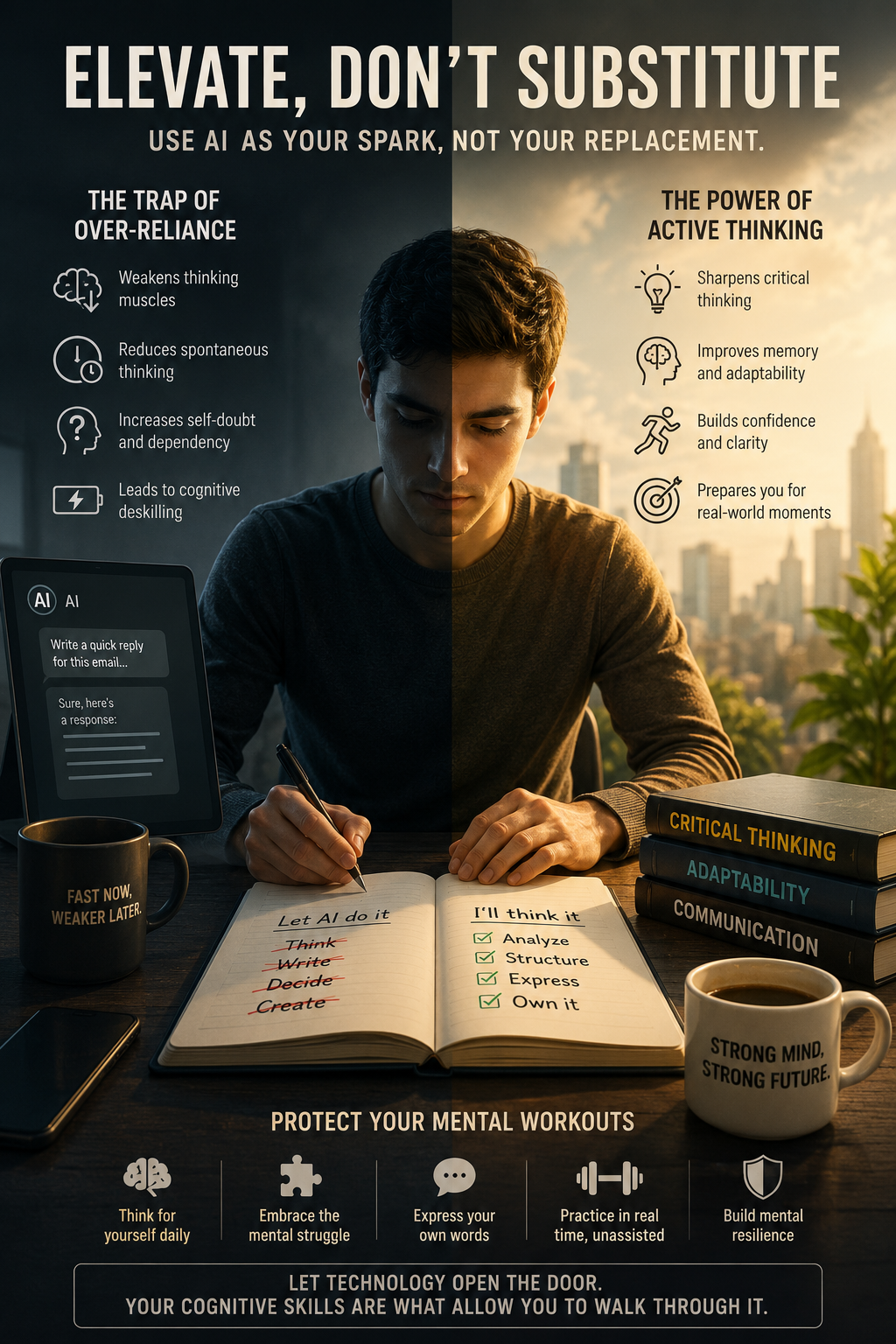
Staying yourself in an Automated World
Let's be honest, when is the last time you wrote a four-sentence email on your own without seeking help from an AI assistant to phrase it?
It all starts as a little lazy thing, even without realization: your short message to a friend, an email to a colleague, or a quick reply in the message stream. But rather than typing it yourself, your fingers run directly towards ChatGPT or Gemini. You type out the instructions, wait a few seconds, copy-paste the results, and send it off.Congratulations, you just gave away five seconds of thinking from your own life.
The Muscle Memory We’re Giving Away
It’s easy to play this down. At the end of the day, where is the real issue? It’s not the four-sentence email, but the quick reply in the chat.
The problem isn’t that single message—it’s the muscle memory, which belongs to us.
Writing isn’t just about putting words onto the screen; it’s the act of thinking for yourself. That short, five-second pause where you gather the accurate word or figure out how to phrase it isn’t a waste of time—it’s a micro-workout for your brain.
The Loss of Spontaneous Thinking
The actual issue isn’t just sending a generic email; the real problem arises when you have to produce a genuine thought in real time, with zero help.
Outside the screen in a fast-moving meeting, a rapid discussion, or an unexpected call—you don’t have an AI assistant. You can’t hold up the conversation for a few seconds to fetch a generated script.
When you offload every small thought to AI, you lose the ability to think on your own. You start second-guessing yourself over simple replies because you are so used to seeing perfectly polished answers that your unedited, natural thoughts begin to feel off.
Will Your Mind Survive the AI Era?
The human brain operates on a non-negotiable biological law: use it or lose it.
When you continuously outsource problem-solving, deep thinking, and sentence structure to AI tools, you aren't just saving time—you are systematically deactivating your cognitive muscles. Neuroscientists describe this loss as cognitive deskilling, driven by excessive cognitive offloading. Every time you trade genuine effort for an instant answer, the neural pathways built through practice and mental struggle begin to weaken.
Protect your mental workouts
To keep your mind sharp in an automated world, you have to actively protect your mental workouts. Real confidence doesn't come from letting a smart tool write or think for you; it comes from training your brain to analyze, structure, and speak for itself.
Final heading: Elevate, Don't Substitute
The goal isn't to delete AI or act like technology doesn't exist—it’s about finding the balance between digital leverage and genuine human effort. Use these tools to spark fresh ideas, break down complex data, or clear always the busywork . But when it comes to forming your perspective, finding your words, and expressing what you want to convey, Drive the process yourself.
Technology is meant to sharpen brainpower, not replace it. By using AI to boost your work ,instead of taking over your mental skills. you protect the fundamental cognitive skills that define how our mind works : critical thinking, short term memory and Adaptability.These mental functions don't stay active on their own,they need constant effort and daily practice . When you push through the effort of framing a thought or solving a problem on your own, You strengthen your brain to stay fast, self sufficient , and built for heavy thinking.
Let technology open the door your cognitive skills are what allow you to walk through it.
Evidence:

Join the Conversation
0 comments
No comments yet
Be the first person to comment.