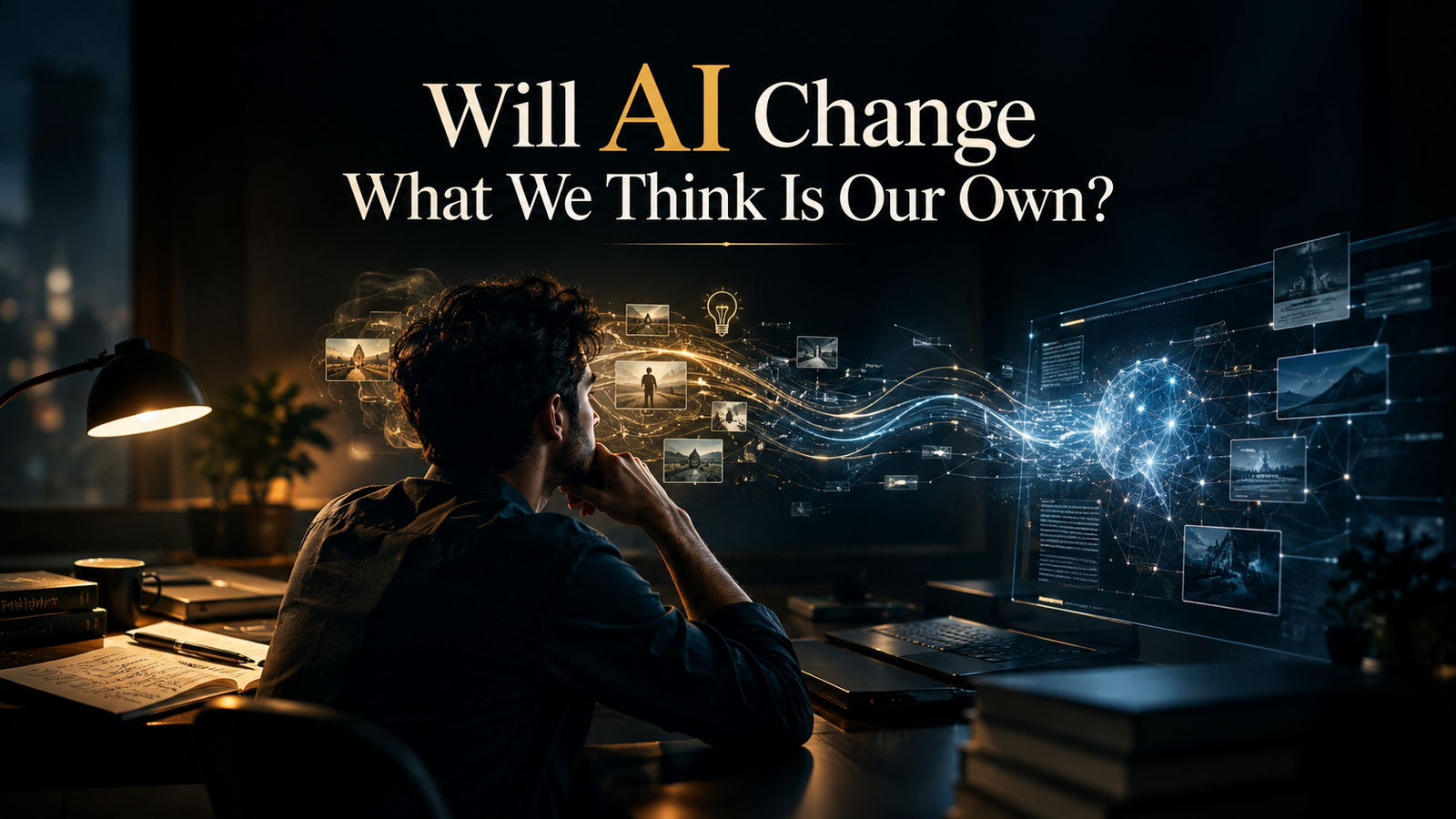
AI AND AUTHORSHIP: WILL AI CHANGE WHAT WE CALL “OUR OWN”?
When technology helps us think, create and decide, where does our contribution begin?
Recently, a question kept coming back to me.
When AI helps me create something, how much of it is still mine?
To explore AI and authorship, I ran a small personal exercise. I took one idea and approached it three ways:
- I developed the idea entirely on my own, with no AI help.
- I gave the same idea to AI and asked it to improve the structure and language.
- I asked AI to produce a fresh version from the same core idea.
This was not a scientific experiment. There was no control group, no formal scoring system and no external evaluator. It was a personal thinking exercise to clarify a question for myself, not proof that AI makes people more or less creative.
What I wanted to notice was where my thinking ended and the machine’s help began. The feeling was uncomfortable.
AI organised my thoughts faster than I could. It suggested phrases I would never have thought of. It turned a messy idea into a polished paragraph, and sometimes stated an argument more clearly than my first draft did.
But I also noticed that it could make me sound convincing about something I never really meant to say. That raised another question:
Is AI improving how I express my idea, or only how my thinking appears?
The Invisible Part of AI Assistance
When we talk about AI, we usually talk about the output: an essay, an image, a presentation, a business idea, a block of code.
But something subtler happens before the output exists. AI now helps us generate, summarise, compare, explain and organise ideas, and explore alternatives. It is becoming part of the thinking process itself.
What Is Cognitive Offloading?
An older psychological concept applies here: cognitive offloading, which means using external tools or resources to reduce the mental load of a task. In a 2016 review in Trends in Cognitive Sciences, Evan Risko and Sam Gilbert examined how people use their environment and external tools to lighten cognitive demands.
There is nothing wrong with this, and humans did it long before AI. We write notes instead of memorising everything. We use calculators instead of doing every sum in our heads. We use maps instead of memorising every road.
Technology has always extended human ability. AI takes the idea a step further. It doesn’t just store information for us; it takes part in creating and organising it. The line between using a tool and handing over our thinking is getting blurry.
We Were Already Doing This Before AI
A 2011 study in Science by Betsy Sparrow, Jenny Liu and Daniel Wegner suggested that when people expect information to stay available online, they may be more likely to remember where to find it than the information itself. It became widely known as the “Google effect on memory.”
We should be careful not to treat it as settled fact. In 2018, Colin Camerer and colleagues attempted to replicate 21 social science experiments published in Nature and Science between 2010 and 2015. The Sparrow study was not successfully replicated under that project’s pre-set criteria.
So the safe conclusion is not “Google makes us forget.” It is this:
When technology changes where information lives and how we reach it, the way we think and use memory may change too.
AI may be the next step on that path, with one important difference. Google retrieves information. AI often generates a brand-new answer.
If AI Gives Me the Answer, Did I Actually Learn?
Suppose I ask AI to explain a difficult topic and I understand its explanation. But I never went through the struggle I would have had working through the problem alone. Did I learn?
Perhaps. But what I learned may be different.
Getting an answer is not the same as building the ability to produce it.
Sometimes the struggle is the point. Wrestling with a hard problem, making mistakes, reorganising our thoughts and finally understanding can build skill. That doesn’t mean every hard task should stay hard. The better question is:
Which difficulties are we willing to hand over to AI?
What the Research Says About Generative AI and Productivity
Studies already show that generative AI can help with certain tasks.
- Writing tasks: In a 2023 Science study, Shakked Noy and Whitney Zhang gave writing tasks to 453 college-educated professionals, some of whom could use ChatGPT. The ChatGPT group finished about 40% faster, and their work was rated about 18% higher in quality on average.
- Customer support: A study of 5,179 customer-support agents by Erik Brynjolfsson, Danielle Li and Lindsey Raymond found an average productivity gain of about 14%. The gain was largest for less experienced workers and much smaller for experienced ones.
- The “jagged frontier”: Research on knowledge workers by Fabrizio Dell’Acqua and colleagues suggests AI’s abilities are uneven. It can help a lot on one task and be unreliable on another.
The picture is more complicated than “AI makes people better.” The benefit depends on the task, the user and how the AI is used.
And productivity is not authorship. Doing something faster is not the same as creating it yourself, and efficiency is not the same as learning. AI can be both a replacement and an assistant, sometimes within the same task.
Who Gets the Credit?
Say I have an idea. AI structures it. I choose the best version. AI rewrites it. I edit the final draft. Who created it?
There isn’t always a clean answer, but authorship was never as simple as we imagined. No writer works alone. We learn language from others, draw ideas from books and teachers, and rely on dictionaries, editors, spell-checkers and search engines. A tool doesn’t erase human authorship by existing.
The better question is: what did the human actually contribute?
- Was there original intent?
- Was there judgement?
- Was there a real choice between options?
- Was there understanding?
- Did they critically review the result?
- Did they take responsibility for what it says?
These questions matter more as AI writes better and better.
The Real Risk May Not Be AI Itself
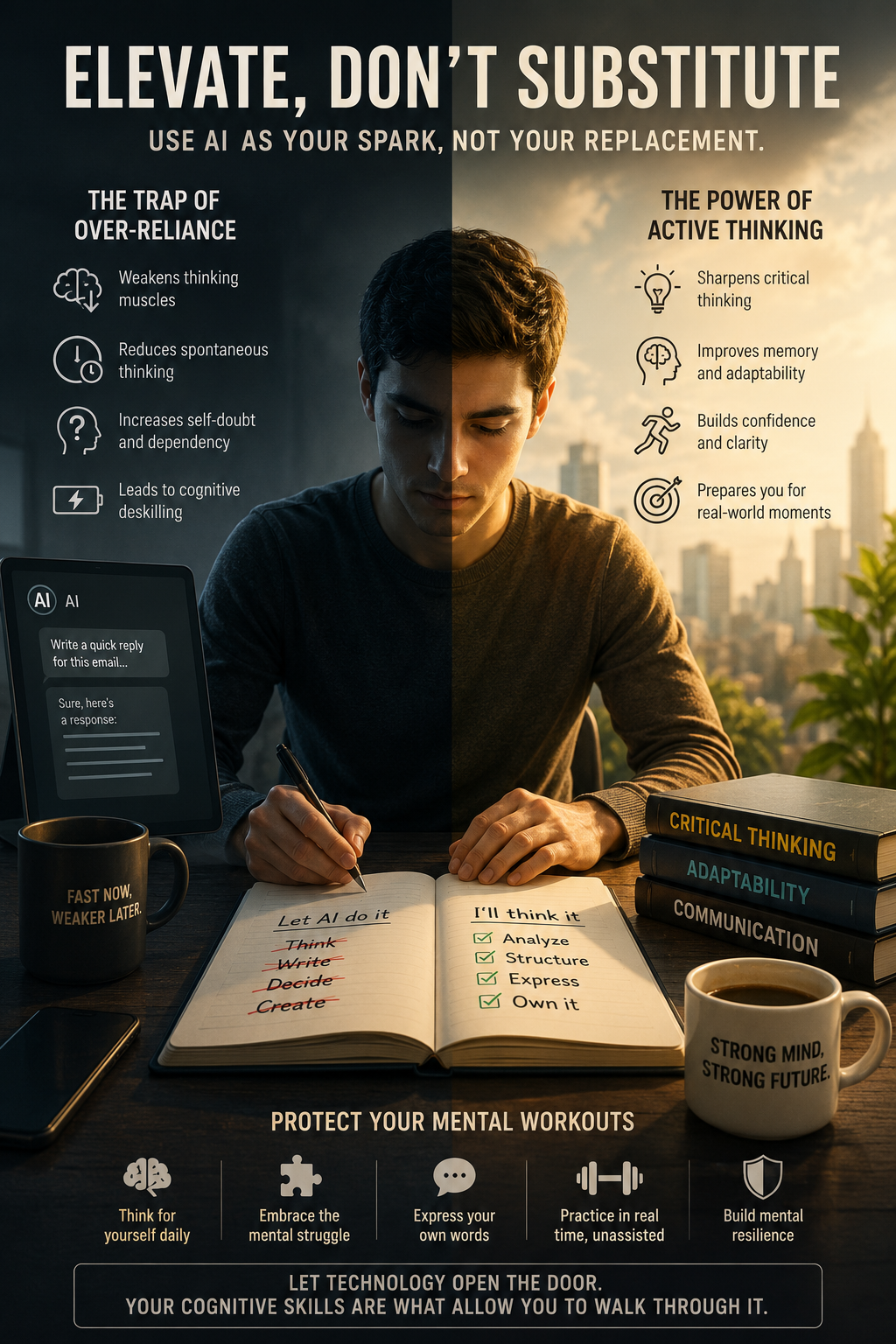
The biggest danger may not be that AI becomes better than us at some tasks. It may be that we stop wanting to do those tasks ourselves.
If AI always writes the first draft, why struggle to write? If it summarises every book, why read deeply? If it generates every idea, why sit quietly and think? If it answers every question, why learn to investigate?
Convenience can slowly turn into dependence. We may not notice, because the machine keeps producing acceptable results, and we may not realise which skills we stopped practising.
An Old Principle for a New Problem
A guiding principle from the Qur’an fits this discussion. In Surah Al-Isra (17:36), Allah says, in meaning:
“Do not follow that of which you have no knowledge.”
The verse isn’t about AI, but its principle is highly relevant in a world of instant information. The issue isn’t only how much information we can access. It is how responsible we are for what we accept, repeat and act on.
AI can produce an answer in seconds, but that doesn’t make it true. It can explain something confidently, but that doesn’t make the explanation correct. It can write in our voice, but that doesn’t make the words truly ours.
The responsibility for what we accept remains with us.
So What Is Truly “Ours”?
Perhaps our contribution isn’t only the words we type. Perhaps it is the intention behind them:
- the question we choose
- the experience we bring
- the values we protect
- the judgement we apply
- the final responsibility we accept
AI can help build a sentence. But why should that sentence exist? That question is different, and it may be where human authorship begins.
I don’t want AI to make me unnecessary to my own thinking. I want it to make me more capable. I’d like to use it to explore ideas, challenge my views, improve my communication and speed up repetitive work, while protecting moments where there is no instant answer. Sometimes thinking is built in the struggle, and sometimes that struggle is how we build ourselves.
In the future, we may not have to choose between human intelligence and artificial intelligence. We may have to learn something harder:
to use powerful tools while remembering that responsibility for what we think, create and believe still rests with us.
So perhaps the real question isn’t only “Will AI change what we call our own?” It is:
“As AI becomes part of our thinking, will we stay aware enough to know what we’ve handed over and what we still need to think through ourselves?”
Frequently Asked Questions
Does using AI mean I’m not the author of my work?
Not automatically. Authorship depends on your original intent, your judgement, your choices and your responsibility for the final result, not only on who typed the words.
What is cognitive offloading?
It’s the use of external tools, such as notes, calculators, maps or AI, to reduce the mental effort a task requires.
Does AI make people more productive?
Research suggests it can, especially in writing and customer support, but the benefits vary by task and by user experience.
Is the “Google effect on memory” proven?
No. The 2011 study was influential, but it did not replicate successfully in a large 2018 replication project, so it should be treated with caution.
How can I use AI without losing my own thinking skills?
Use AI to explore ideas and speed up repetitive work, but keep doing the hard thinking yourself, and critically review everything it produces.
References
- Sparrow, B., Liu, J., & Wegner, D. M. (2011). “Google Effects on Memory: Cognitive Consequences of Having Information at Our Fingertips.” Science, 333(6043), 776–778.
- Camerer, C. F., et al. (2018). “Evaluating the Replicability of Social Science Experiments in Nature and Science between 2010 and 2015.” Nature Human Behaviour, 2(9), 637–644.
- Risko, E. F., & Gilbert, S. J. (2016). “Cognitive Offloading.” Trends in Cognitive Sciences, 20(9), 676–688.
- Noy, S., & Zhang, W. (2023). “Experimental Evidence on the Productivity Effects of Generative Artificial Intelligence.” Science, 381(6654), 187–192.
- Brynjolfsson, E., Li, D., & Raymond, L. R. (2023). “Generative AI at Work.” NBER Working Paper No. 31161.
Dell’Acqua, F., et al. (2025). “Navigating the Jagged Technological Frontier.” Organization Science.
AI Use Disclosure
AI was used in preparing this article to organise arguments, refine language and structure the draft. The central question, personal reflections, decisions and final opinions are the author’s own, and the author takes responsibility for them.
Join the Conversation
0 comments
No comments yet
Be the first person to comment.